


EMOTIONAL JOURNALING – A SIMPLE TOOL TO RELIEVE ANXIETY WITH KELAM CENTER
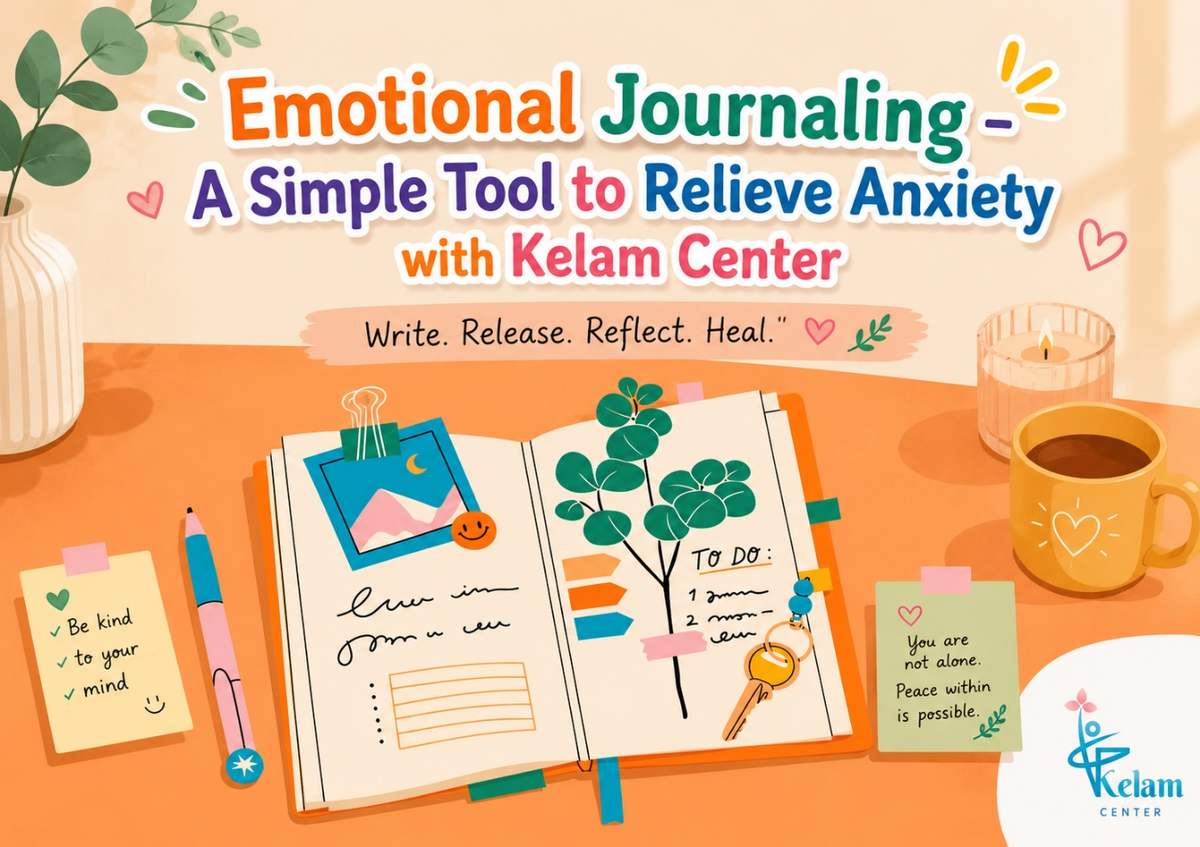
Emotional journaling is a simple and gentle form of healing in a modern life filled with countless worries and demands. These pressures can easily leave us trapped in prolonged stress and anxiety.
How many times have you quietly carried the weight of your worries all by yourself? You keep all your negative thoughts locked inside and eventually feel so overwhelmed that you become emotionally and physically exhausted.
The world constantly seems to demand perfection from us. That is why finding a safe place to release the burdens within has become more important than ever.
If you are looking for a way to heal yourself, consider exploring emotional journaling. It is a natural, simple, and completely free form of self-help. It can help ease anxiety, release tension, and help you regain a sense of peace and balance in your life.
From a psychological perspective, journaling is more than simply expressing emotions. It can also serve as a form of self-healing grounded in psychological principles.
1. What Is Emotional Journaling? From Emotional Chaos to Mental Clarity
Greenberg (2006) introduced the Emotion Processing Model, which suggests that emotions are an essential part of navigating our psychological states. However, when emotions are not processed properly, they can contribute to stress, anxiety, or depression.
Emotional journaling creates a space for transformation. It can help transform primary emotions, such as fear and anger, into more adaptive emotional states, such as gratitude and forgiveness.
Emotional journaling is also scientifically known as Emotional Journaling. It is a form of free writing that focuses entirely on your inner world.
Unlike an ordinary notebook used simply to record daily events, emotional journaling is a place where you courageously remove the layers of social masks and face yourself honestly.
You name and express your deepest emotional states and thoughts. You are not simply recounting what happened during the day. Instead, you are practicing a powerful form of healing through writing.
It allows you to touch the deepest layers of your inner world—to gently embrace your hidden wounds, emotional burdens, and the pressures you have been quietly carrying.
Distinguishing an Event Journal from an Emotional Journal
An event journal records “What did I do today?”, while an emotional journal asks, “How did I truly feel today?”
To make the distinction clearer, we can easily differentiate between these two familiar forms of journaling:
- Ordinary Event Journal: An ordinary event journal is mainly used to preserve a record or schedule. It focuses on surface-level questions such as: “Where did I go today? What work did I do? Who did I meet?” The content revolves around timelines, workplace tasks, homework, or other external activities and events.
- Emotional Journal: An emotional journal is more inward-looking and deeply reflective. It directs your attention toward psychological questions that help you explore what is happening beneath the surface. For example: “How did I truly feel today? Why did an offhand comment from my colleague hurt me so deeply? Where did this anxiety or anger come from?”
Do not simply drift along with the stream of external events.
Emotional journaling gives you a safe, judgment-free space to understand yourself more fully. As your words begin to flow onto the page, you are practicing the active management of your emotions.
You are transforming negative, chaotic emotional energy into inner stillness, clarity, and understanding.
2. The Science Behind It: Why Does Journaling Help Relieve Anxiety?
Writing helps transform chaotic emotions into language and logical thought, which may help calm the amygdala.
Journaling is not merely a hobby or a quiet mindfulness practice. Research suggests that writing can have meaningful effects on the brain.
Below are some of the key mechanisms that help explain why putting your thoughts and feelings onto paper can soothe anxious states:
2.1. Calming the Nervous System: Turning Chaos into Order
When we face stress, the brain often enters a state of alert. The amygdala, in particular, plays an important role in emotional processing. This can make our thoughts feel tangled, overwhelming, and difficult to organize.
When you practice emotional journaling, abstract thoughts in your mind are translated into concrete words on paper. This process requires the brain to organize and process information through language and reasoning.
The right hemisphere is often associated with emotional processing, while the left hemisphere is more strongly involved in language and logical processing.
This process of “giving shape” to your thoughts helps the brain identify and organize the problem more clearly. In turn, it may support the parasympathetic nervous system and help the body move toward a calmer state, allowing anxiety to gradually ease.
2.2. Reducing the Load on Working Memory: Breaking Free from the Overthinking Loop
Human working memory has a very limited capacity.
You may try to hold too many worries, work deadlines, and invisible fears inside your mind. Eventually, this mental space becomes overloaded. One consequence can be overthinking.
Journaling works like an “external hard drive” for the mind.
By transferring your mental burdens from your head onto the page, you free up cognitive space. Your mind can therefore feel lighter.
You no longer have to constantly strain yourself to remember and worry about things that have not even happened yet.
2.3. Developing an Objective Perspective: Looking at Problems with a Clearer Mind
When anxiety surrounds us, we often exaggerate situations and create the worst possible scenarios in our minds.
But try writing those thoughts down.
Then, read your own words again after a few minutes or a few days. Something remarkable may happen: you begin to see yourself from the position of a neutral observer.
Look at the page as though it were a mirror reflecting your thoughts.
This process helps you create some distance from the intense emotions you initially experienced. From there, you can look at the situation with greater calmness and clarity.
You may then discover solutions that are more reasonable, gentle, and balanced.
2.4. The Expressive Writing Effect: A Release for the Soul
James W. Pennebaker (1986) was a pioneer in the study of expressive writing.
He discovered something important: writing about painful emotional experiences can help reduce stress and improve psychological well-being.
This process has been associated with reduced activity in the limbic system, particularly the amygdala, while engaging areas of the prefrontal cortex involved in emotional regulation and thoughtful decision-making.
3. The Wonderful Benefits of Daily Emotional Journaling
Research by Smyth (1998) reported a noteworthy finding: people who wrote about their emotions for 15–20 minutes a day over 3–5 consecutive days experienced significant improvements in psychological and physical well-being.
According to Baikie & Wilhelm (2005), expressive writing may not only help reduce anxiety but may also improve sleep and strengthen the ability to cope with stress.
Each day, you only need 15 to 20 minutes to sit down and have a quiet conversation with a blank page.
It is more than a relaxing habit. It is an invaluable investment in your mental well-being.
Here are some practical benefits emotional journaling can bring into your life:
3.1. Healing Through Writing: The Power of Honestly Expressing Your Emotions to Yourself
- Releasing suppressed emotions: An emotional journal can become like a friend who listens without judgment. It is a place where you can freely express all your thoughts and feelings.
- Encouraging self-forgiveness: The process of writing can help you understand the pain of your past more clearly. You learn to accept it and gradually let it go.
- Cultivating positivity: Record the good things in your life through gratitude journaling. This practice may improve mood and reduce symptoms of depression (Emmons & McCullough, 2003).
3.2. Emotional Journaling Helps Relieve Stress in the Moment
Life will always bring unexpected pressures. They can easily leave you feeling irritated, angry, or suddenly sad.
Instead of suppressing these emotions or taking them out on other people, write everything down as honestly as possible. It is like a safe pressure-release valve.
Negative emotional energy is transformed into words and left on the page. And in that moment, you may feel an immediate sense of lightness in your chest.
3.3. Emotional Journaling Improves Sleep Quality
Restlessness and insomnia often have a simple underlying cause: your brain continues racing through countless thoughts and worries about tomorrow even after you have gone to bed.
Making journaling part of your bedtime routine can act as a form of mental “clean-up.”
It helps you close the day with greater peace, allowing you to drift into deeper, more restful sleep without being disturbed by endless overthinking.
3.4. Encouraging Gratitude and Positive Thinking
A journal is not only a place to release emotional “waste.” It can also hold the gentle moments and small achievements of your day.
Maintaining this habit can gradually train the brain to notice and seek out the good things in life.
Little by little, your mindset can shift away from negativity and constant complaining. You begin to appreciate the present moment and live with greater optimism each day.
4. A Detailed Guide to Effective Emotional Journaling and Building a Sustainable Habit
A quiet corner, a consistent time, and 10 minutes each evening—a simple formula for building the habit.
Emotional journaling can provide a powerful way to support self-healing and relieve anxiety.
To make the most of it, however, it helps to understand how to organize your practice—including your environment, timing, and writing duration.
Here is a detailed guide to help you make the most of each journaling session.
4.1. Tips for Making Your Journaling Sessions More Effective
- Find a Quiet Space: Choose a private corner where you will not be disturbed by people or surrounding noise. It could be a familiar corner of your room—or simply sitting quietly inside your parked car after a long and exhausting workday.
- Choose a Relaxed Time: Write when you are not in a hurry and your daily responsibilities have been completed. You might use a peaceful moment after work or after your children have gone to bed. You can also keep a notebook beside your bed so that you can easily reflect before falling asleep.
- Stay Consistent and Regular: Build a long-term habit by choosing a specific time each day. For example, set aside exactly 10 minutes every evening for journaling.
- Write Continuously and Without Judgment: Allow your pen to move freely during your chosen period. Do not worry about spelling or grammar. Simply focus on allowing your thoughts to flow. Sometimes you may feel stuck and not know what to write. If that happens, simply repeat the words you have just written until your emotional flow begins to return.
Focus Inward and Use Open-Ended Questions
Focus Deeply on Your Emotions Rather Than the Events. Do not get lost in describing every detail of what happened during the day. Turn the lens inward. Ask yourself how your body is responding. What emotion are you immersed in right now—anger, hurt, anxiety, or gratitude?
Use Flexible, Open-Ended Prompts. Sometimes you may feel stuck and have no idea where to begin. Ask yourself guiding questions such as:
- “What happened today that touched my emotions the most?”
- “What is this emotion trying to protect me from?”
- “What do I truly want after this experience?”
Never Judge Yourself. Let go of every fear about spelling, grammar, or sentence structure. Do not be afraid to “write exactly what comes to mind.” The blank page is an unconditional listener. So let your pen move freely and honestly. Allow yourself to write down even your most private thoughts.
4.2. The Ideal Duration and Frequency for Emotional Journaling
- Be Flexible with Your Practice Time: Early expressive-writing studies often used a formula of 15 minutes a day for four consecutive days. However, other research has also suggested that shorter or longer writing sessions can provide meaningful benefits.
- Prioritize Consistency: Writing regularly is generally more beneficial than writing only from time to time. It allows you to continuously reflect, review your experiences, and develop your thinking.
- A Guideline for Writing Duration: Set a minimum goal of writing for at least 2 minutes. On the other hand, you may become absorbed and want to explore your thoughts more deeply. If so, consider setting a 30-minute timer and stopping when it ends to avoid emotional overload.
4.3. Important Considerations for Building a Sustainable Habit
- Start with Short Sessions: Do not pressure yourself to fill an entire page with writing. You can begin gently with just 5 to 10 minutes a day. The consistency built through small amounts of time is what ultimately creates meaningful change.
- Stay Flexible and Do Not Force Yourself: Think of your journal as a trusted companion who is always ready to listen. It is not a “homework assignment” that you must complete. Some days you may be too tired and simply not want to write. Allow yourself to rest without feeling guilty.
- Protect Your Privacy: Emotions can be expressed most fully and honestly when you know that your space is completely safe. Choose a notebook with a lock or a secure note-taking app on your phone. You can also keep your journal somewhere private. This allows you to pour your heart out freely without worrying about being judged or having someone secretly read your words.
5. Common Pitfalls to Avoid and Tips for Safe, Effective Emotional Journaling
Emotional journaling is a wonderful and highly flexible self-healing practice. However, practicing it in the wrong way can sometimes have the opposite effect.
If you want to relieve anxiety effectively without falling into psychological traps, keep the following important points in mind.
Know When to Stop and Change the Topic When You Feel Overwhelmed
Listen to your body and your emotions. Sometimes you may encounter painful memories or emotional wounds. This can temporarily overwhelm you emotionally.
A particular topic may feel simply too painful or uncomfortable. When that happens, do not force yourself to keep writing.
Pause and shift to a different approach, such as gratitude journaling. You can also give yourself permission to take a few days off.
Do Not Let Journaling Replace Real-World Action
A journal is a place to express yourself. But it cannot solve real-life problems on your behalf.
Continuously complaining about a situation that is within your control will not create meaningful change. Always ask yourself: “Is this situation within my control?”
For example, do not spend endless pages writing about your frustration because a family member neglects household responsibilities or because you are anxious about an exam. Combine reflection with concrete action, such as having an honest conversation or creating a clear study plan.
Avoid Turning Your Journal into an Endless Outlet for Negative Anger
You may use the page only to list everything that went wrong or to nurture resentment—for example, blaming your boss or remaining angry at an ex-partner. When this happens, you may remain trapped in a cycle of negativity without moving toward healing.
Try to shift from simply releasing emotions to examining your thoughts.
Research points to something important: people who only write about stress without trying to understand or cope with it may be more vulnerable to emotional exhaustion.
So always ask yourself: “What is the root cause?” and “What can I do about it?”
Journaling Prompts to Help Relieve Anxiety Effectively
When you run out of ideas, journaling prompts can help you explore your inner world and gently release anxiety.
When you are under stress, not knowing what to write can make you hesitate to pick up your pen. Below is a thoughtfully designed set of prompts to help you explore your inner world, face your emotions, and gently ease anxiety.
1. Identify and Name Your Emotions
- What is worrying me the most today?
- Where do I feel this emotion in my body—my chest, stomach, or head?
- If I were to describe my current emotion as an image, a type of weather, or a color, what would it look like?
- Which words describe my current emotional state most accurately: sadness, anger, anxiety, or exhaustion?
2. Examine and Challenge Negative Thoughts
- Is the worst thing I am imagining actually happening?
- Is there any real evidence supporting my fear right now, or am I creating assumptions in my mind?
- If a close friend were experiencing exactly what I am experiencing, what would I say to them?
- What percentage of this situation is actually within my control?
3. Turn Reflection into Action and Find Inner Peace
- What is one small action I can take right now to feel a little better?
- Was there anything wonderful or peaceful today—even something very small—that I unintentionally overlooked?
- What can I choose to let go of right now so that my mind can feel lighter?
- At this very moment, what am I most grateful for in my life?
Closing Thoughts
Emotional journaling is more than simply a habit of keeping records. It is a key that opens a safe space where you can understand, embrace, and heal yourself.
The world outside can be busy, demanding, and overwhelming. So give yourself a few quiet minutes each day to have a gentle conversation with a blank page.
Release the burdens you have been carrying, and allow your soul to return to the peace that has always belonged to it. Emotional journaling can be the beginning of that journey.
Caring for your mental well-being begins with the smallest acts of self-care. So pick up your pen today, and begin writing your own story of healing.
Note: This information is provided for reference purposes only. For medical advice or diagnosis, please consult a qualified healthcare professional.
Continue Your Journey
You want a complete guidance to overcome your anxiety disorder?
Purchase the book Journey to Freedom and Inner Peace at: https://actapublications.com/journey-to-freedom-and-inner-peace/
You can listen to Chapter 1 of the book here or via our Youtube channel: https://youtu.be/5CjrQpIef4Q
We deserve to live a life of freedom and adventure
#journeytofeedomandinnerpeace #kelamcenter #doanthilam #actapublications #healing #anxietydisorder